

The Daily Patriot
British News · Patriotic Voice
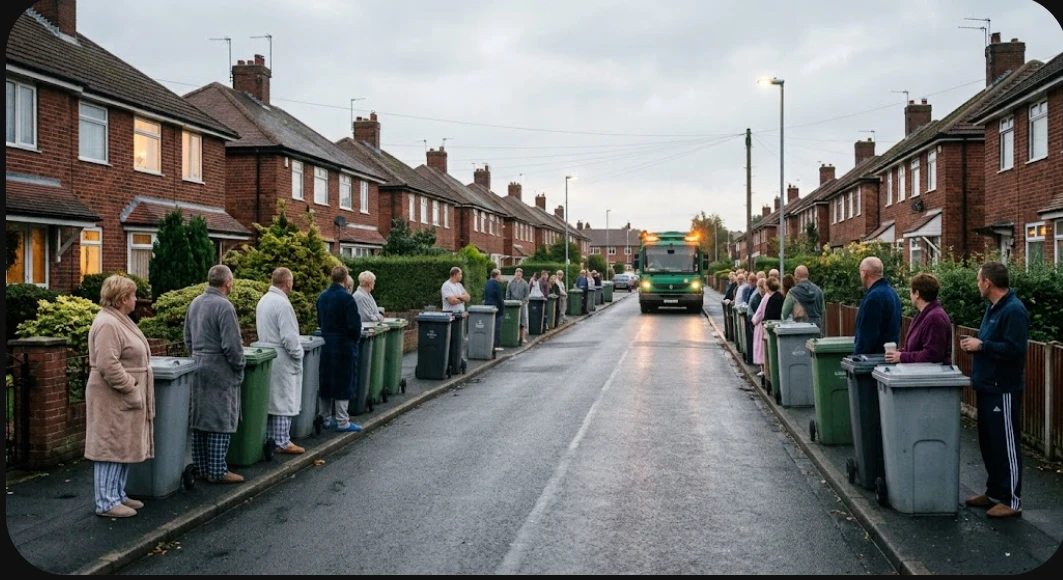
Residents will soon be expected to line up along their streets every Tuesday morning, manually hoist their own wheelie bins onto passing lorries, and operate the hydraulic lift mechanism themselves as part of a radical council cost-cutting scheme.
Under the new “Streamlined Assisted Collection Kerbside Directive,” Slough Borough Council will make all frontline refuse collectors redundant, retaining only the lorry drivers.
To ensure the system functions smoothly, households must stand at the edge of their driveways, hook their bin onto the truck’s mechanical arm as it passes, press the green cycle button, and return the empty container to their property immediately.
The council estimates the move will plug a £4.2 million hole in its budget, saving vast sums on crew wages, high-visibility jackets, and corporate gym memberships for loaders.
A council spokesperson defended the controversial overhaul at a tense town hall meeting on Monday night.
“Our data shows that the average resident already takes their bin to the end of the drive every Tuesday morning so there’s no reason why they can’t drag it an extra ten feet and push a button.”
To prepare households for their new duties, the council is launching a mandatory four-minute online safety module titled “Bin Lifting & Lever Mechanics for the Everyday Citizen,” alongside strict timing rules: the bin lorry will stop for three minutes only, and residents who miss their loading window will have to wait until the following fortnight.
Elderly or infirm residents will be permitted to nominate a “Designated Community Hoister,” provided they submit a notarised authorisation form 14 days in advance.
The plan has already met fierce resistance from rate-paying unions and neighbourhood watch groups.
“It’s utterly absurd,” said local resident Brenda Hargreaves. “Last week I had to perform a three-point turn around a delivery van just to get out of my drive, and now I’m expected to operate heavy industrial machinery in my dressing gown before my morning tea?”
Despite the pushback, council bosses remain confident the scheme will set a benchmark for public sector efficiency, with preliminary plans already being drafted to have residents sweep their own roads and bring their own asphalt to patch potholes.